Healing Through Creativity: Art for Emotional Growth

There are things we can say with paint, pencil, movement and color that we sometimes cannot say with words. Creativity gives emotion somewhere to go. And sometimes, in the process of making something, we understand ourselves a little better.
Art as a Healing Tool
Humans have been creating for as long as we have evidence of human existence. Long before anyone used the term art therapy, people painted on cave walls, carved objects, made music, told stories and used images to communicate ideas that mattered to them.
We cannot know exactly what every ancient image meant to the person who created it, but I find it difficult to believe that our impulse to create was ever purely decorative. Human beings have always needed ways to make sense of life, death, fear, love, the unknown and everything in between.
Art therapy eventually developed into a formal therapeutic practice. British artist Adrian Hill is generally credited with coining the term “art therapy” in the 1940s after experiencing the value of art-making while recovering from tuberculosis. He recognized that drawing and painting could offer patients more than simply something to occupy their time. Creativity gave people an outlet when their circumstances, and sometimes words themselves, could not.
Today, art therapy is a recognized form of psychotherapy practiced by trained professionals. But you do not have to be in formal art therapy to experience something therapeutic through creating. Making art for yourself is different from working with an art therapist, but the simple act of giving an internal experience an external form can still be incredibly powerful.
The Healing Power of Art
There is something to be said about a piece of art that stops you when you see it.
Most of the time, I don't think people are responding only to an artist's technical skill. They are recognizing something.
Maybe it is an emotion they have felt before. Maybe it reminds them of a person, a moment or a version of themselves. Sometimes they don't even understand why they are reacting to it.
For me, that is one of the markers of good art.
You can be moved by my art. You can question it. You can be confused by it. You can even be angry because of it.
Just don't be indifferent to it.
Because somewhere inside that reaction is recognition.
Art does not always heal because it makes us feel better. Sometimes it heals because it allows us to feel something we have been avoiding.
Some of humanity's most enduring creative work has emerged during and after periods of upheaval, grief, uncertainty and change. We create from pain. We create from love. We create from longing, frustration, curiosity, obsession and joy.
Strong emotion asks to go somewhere.
When we don't give it somewhere to go, it can sit inside us, repeating itself. Creativity gives it another language.
A painting will not necessarily solve the thing you are struggling with. A sketchbook will not magically answer every question. But sometimes putting an emotion outside of yourself, onto paper, canvas or into some other form, changes your relationship with it.
You can finally look at it.
And sometimes that is where healing begins.
Personal Growth Through Creativity - or Creativity Through Personal Growth?
I think it works both ways.
Personal growth can fuel art, particularly when you allow yourself to put more of who you actually are into what you create. At the same time, creating can help us process experiences that eventually lead to that growth.
Earlier in my life, art often helped me heal. As I grew older, I noticed something shifting: my healing began fueling my creativity.
I have always enjoyed creating, but for a long time I felt that something in my work was flat. Technically, I could make something beautiful. I could paint what I saw. But there was a distance between me and the work.
One of the reasons was simple: I was afraid to put too much of myself into it.
There was a voice in my head asking whether people would think what I was creating was weird. Was it too personal? Was I revealing too much? Would anyone understand what I was trying to say?
Eventually, I realized that trying to avoid those questions was exactly what was holding the work back.
Because once I began allowing my own experiences, questions and symbolism into my art, the work started feeling alive.
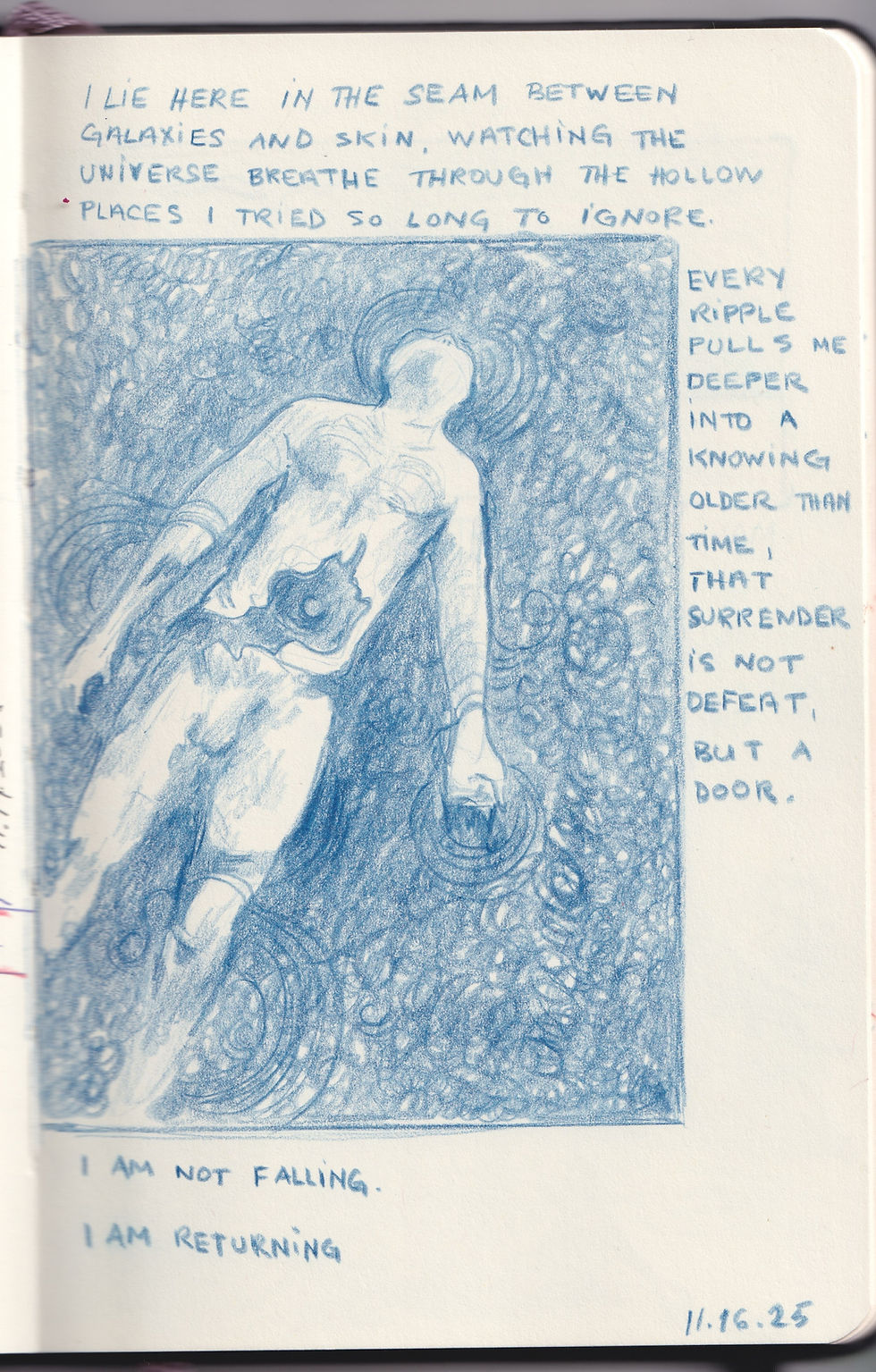
Birds could become messengers instead of simply birds. A figure could represent more than a body. A veil could become the division between what we know and what we sense exists just beyond it. Space, light, human connection and the unseen could become visual language for things I didn't necessarily know how to explain any other way.
The work became less about painting something and more about exploring something.
And interestingly, the process worked in reverse too.
Painting or drawing something that was difficult to articulate gave me the opportunity to place it outside myself. I could examine it, change it, cover parts of it, bring other parts forward and sometimes discover connections I hadn't consciously made before.
Art became a conversation.
Not necessarily with an audience.
With myself.
That is where I think creativity and personal growth begin feeding each other. The more willing you are to understand yourself, the more honest your creative work can become. And the more honestly you create, the more the work can reveal about you.
Practical Ways to Use Art for Healing
You do not have to consider yourself an artist to use creativity as an emotional outlet.
In fact, if your goal is emotional exploration, worrying about whether something is “good” can defeat the entire purpose.
Try creating something that nobody else ever has to see.
Keep a Visual Journal
Instead of writing everything you are feeling, combine words with sketches, colors, shapes, photographs or pieces of paper. A visual journal does not need to look like one of those impossibly beautiful sketchbooks you see online.
Let it be messy.
The purpose is not presentation. The purpose is honesty.
Paint an Emotion Instead of an Object
Choose something you are feeling and ask yourself what it would look like if it had no recognizable form.
What color is frustration?
What shape is grief?
Does anxiety have sharp edges or soft ones?
What does peace look like?
Removing the need to paint an identifiable object can make creating surprisingly freeing.
Draw Without a Plan
Put your pencil on the paper and move it without deciding what you are drawing first.
Follow shapes. Repeat marks. Turn the page. Add another medium.
Our instinct is often to control what we are making. Occasionally, it is useful to see what happens when we don't.
Create From a Memory
Think about a memory that still carries emotion for you. Instead of illustrating exactly what happened, paint the feeling of the memory.
You may be surprised by which details become important.
Take a Sketchbook Somewhere
Go outside. Sit in a café. Walk through a city. Sit in your own backyard.
Draw badly.
That part is important.
You are not making a finished work of art. You are practicing the act of slowing down long enough to notice what is around you.
Sometimes creativity heals simply because it brings us back into the present.
If You're a Beginner, Forget About Being Good
One of the unfortunate things that happens as we grow up is that creativity starts acquiring rules.
Children draw without wondering whether they are talented enough to draw. They make up songs without wondering whether they can sing. They write stories without asking whether anyone would publish them.
Adults often decide they aren't artists, writers, musicians or poets before they ever begin.
I have done this myself.
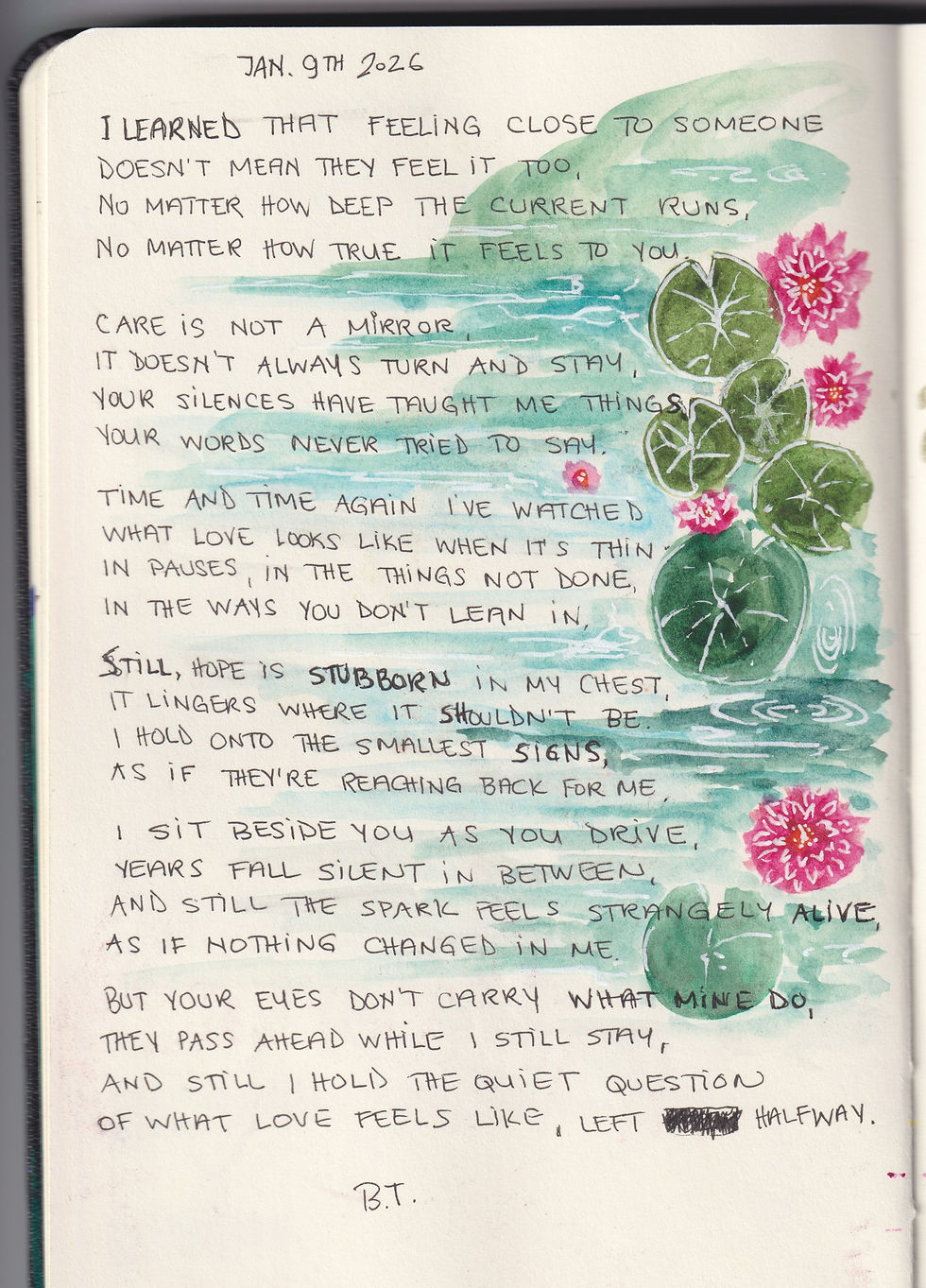
Sometimes, when I have been trying to work through something emotionally, I have written poetry. For a long time, I would have felt self-conscious even saying that because I never considered myself a particularly good writer, let alone a poet.
Eventually, I realized that didn't matter.
I wasn't writing because I was trying to become a poet.
I was writing because something inside me needed somewhere to go.
There were feelings I couldn't quite explain in ordinary conversation, but when I stopped worrying about whether the writing was good and simply allowed the words to come out, they found their own form.
Writing gave those emotions a place outside of me.
Whether anyone else would consider the result a good poem became almost irrelevant.
The act of creating it had already done what I needed it to do.
I think we sometimes deny ourselves that kind of release because we believe creativity belongs only to people who are talented at a particular thing.
It doesn't.
You don't have to be a painter to paint.
You don't have to be a writer to write.
You don't have to be a poet to write a poem.
And you certainly don't need to show anyone what you create.
If you want to explore creativity as a form of emotional growth, forget about making something that is good enough to frame, publish, post online or show another person.
Start with ten or fifteen minutes.
Buy an inexpensive sketchbook. Pick up watercolor, pencils or markers. Write a page in a notebook. Write a poem even if you have never written one before. Put on music and move around your living room if that is what feels right.
Then make something for absolutely nobody.
Do not think about Instagram. Do not think about whether it fits your style. Do not think about whether anyone would buy it, understand it or think it is good.
Ask instead:
What am I actually trying to say?
Or, perhaps more importantly:
What is trying to come out of me?
Then let it.
When Creativity Starts to Change You
For me, one of the biggest transformations in my own work happened when I stopped needing every piece to be immediately understandable.
There are ideas I return to repeatedly: connection, separation, identity, the visible and invisible, masculine and feminine energy, the strange threads that seem to connect people and experiences across time.
I don't always begin a painting knowing exactly what I think about those things.
Sometimes I paint because I am trying to find out.
That distinction changed the way I approached creativity.
Art doesn't always have to illustrate an answer.
Sometimes the artwork is the question.
And perhaps that is one reason creativity can be so powerful during periods of personal growth. Growth itself is rarely clean or linear. We outgrow versions of ourselves. We contradict ourselves. We discover that something we once believed no longer fits. We become interested in questions we previously ignored.
Art gives all of that uncertainty somewhere to exist without requiring us to resolve it immediately.
A canvas can hold contradiction.
A sketchbook can hold confusion.
A poem can hold something you are not ready to say out loud.
A painting can contain something you are not ready to explain.
There is tremendous freedom in that.
Create the Thing You Are Slightly Afraid to Create
Art cannot replace professional mental health care when that care is needed, and making art on your own is not the same thing as working with a trained art therapist.
But creativity can still become part of the way we understand ourselves.
It can help us slow down. Pay attention. Externalize emotion. Recognize patterns. Revisit memories. Ask uncomfortable questions. And occasionally discover that something we thought we were creating simply because we liked the idea was actually trying to tell us something.
You don't need a studio.
You don't need expensive materials.
You don't even need to call yourself an artist.
You just need to give yourself permission to create without immediately judging what comes out.
And if you already make art but feel like something is missing from it, perhaps the answer isn't another class, another technique or another supply.
Maybe the next step is putting more of yourself into it.
The strange parts.
The unresolved parts.
The things you cannot explain neatly.
The things you have lived through.
The things you are still trying to understand.
Start there.
Make the thing you are slightly afraid to make.
It might be the work that finally tells you the truth.
A few personal pages from my sketchbooks that helped me heal:





Comments